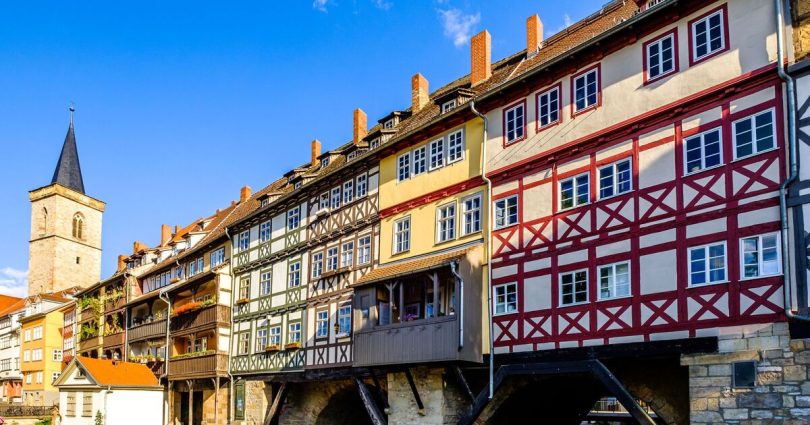

Nestled in the heart of the city of Erfurt in Thuringia, Germany, you’ll find a heritage-listed medieval arch bridge that not only connects different parts of the city for locals, but also houses them. The Krämerbrücke, known as the Merchant’s Bridge, is the longest series of inhabited bridges in the whole of Europe.
Spanning 125 metres, the bridge was originally constructed from wood, but was rebuilt in stone in 1325. Initially it was home to 62 narrow buildings along its length, but subsequently, redevelopment left just 32. The earliest mentions of the bridge date back to 1156, when it was noted in documents as ‘Pons rerum venalium’, which translates to the bridge of offered things, according to the bridge’s official website.
The bridge was boasts six arches made from sandstone, while the foundation of bridge piles contain hidden cellar vaults. Its eventual remodelling hints at Gothic, Renaissance, Baroque inspiration.
Connecting two parts of the city along the Gera river, it became an important location for the local merchants and traders to flog their wears in small wooden huts along the bridge during the Middle Ages. The bridge ultimately received its name from the merchants who traded in fine fabrics, spices and jewellery.
The bridge once boasted a pair of bridgehead churches at each end, St Aegidius (St Giles) Church at the east, and St Benedict’s Church at the west end. However, only St Giles remains at the eastern end, where you can catch an impressive view of the bridge from its tower. There is a height of 33 metres to the top of the spire.
Over the following centuries, the bridge experienced a number of repeated fires, leading to a number of the timber-framed houses being remodelled between the 16th and 18th centuries. The 62 houses were gradually merged into 32.
Following the Reformation, the use of the churches dwindled, with St Benedict’s Church ultimately being passed into private ownership. The church would be demolished at the beginning of the 19th century.
Krämerbrücke underwent a number of restoration efforts, including the construction of the Rathausbrücke to accommodate increasing traffic. Following the wars of the 20th century, the Krämerbrücke endured damage and led to a number of modern restoration projects.
Today, along with the homes of the locals, you’ll now find the bridge lined with an eclectic mix of galleries, cafés and boutiques offering traditional crafts, Thuringian blue printed fabrics, ceramics, handblown glassware, jewellery, wood carvings, antiques and delicious Thuringian delicacies.
Source link


