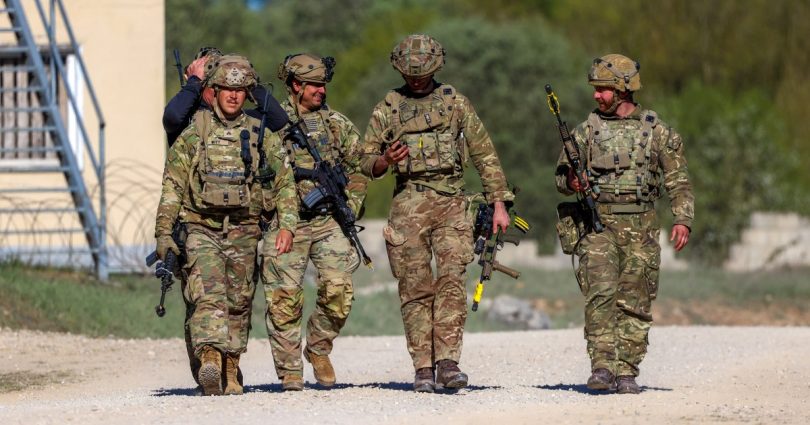

European leaders called for the continent to learn how to defend itself Saturday after Pentagon officials said the U.S. was withdrawing approximately 5,000 troops from Germany.
Subscribe to read this story ad-free
Get unlimited access to ad-free articles and exclusive content.

The pullout decision came after Chancellor Friedrich Merz said the U.S. had been “humiliated” by Iran, causing a spat with Washington and capping weeks of President Donald Trump’s frustration that U.S. allies in Europe are not doing enough to help with the spiraling crisis in the Middle East.
It comes at a time of deep divisions between Washington and its European allies, with trans-Atlantic tensions already heightened by tariff threats, U.S. pressure on Ukraine to make concessions to Russia in exchange for peace, and Trump’s push earlier this year to take over Greenland, the semiautonomous territory of NATO ally Denmark.
“That the U.S. would withdraw troops from Europe and also from Germany was foreseeable,” German Defense Minister Boris Pistorius in a statement on Saturday. Almost 40,000 U.S. troops are currently stationed in Germany, he said — the largest contingent in Europe and a key logistics hub for American forces on the continent.
“We Europeans must assume more responsibility for our security,” he added. “Germany is on the right track.”
Berlin has already been expanding its armed forces, procuring more equipment, focusing on innovation and building more infrastructure, Pistorius said.
For weeks, Trump has been vocal about his discontent with NATO and European allies, including Germany, for their lukewarm to nonexistent support for his war with Iran. He has also threatened to pull the U.S. out of NATO, while Trump administration officials have warned that the relationship with the U.S. allies can’t be a “one-way street.”
News of the partial U.S. troop pullout from Germany was met with a degree of pragmatism but also alarm in European capitals and at NATO’s headquarters in Brussels.
NATO spokesperson Allison Hart said the alliance is working with the U.S. to understand the details of its decision for the drawdown.
“This adjustment underscores the need for Europe to continue to invest more in defense and take on a greater share of the responsibility for our shared security,” she said, adding that NATO allies had already agreed last year to invest 5% of their GDP in defense.
Polish Prime Minister Donald Tusk called for the reversal of a “disastrous trend” in which Europe and Washington grow farther apart.
“The greatest threat to the transatlantic community are not its external enemies, but the ongoing disintegration of our alliance,” Tusk, whose nation sits on NATO’s eastern flank and is heavily reliant on the alliance in countering the Russian threat in neighboring Ukraine, wrote in a post on X Saturday.

FORSUBSCRIBERS
Was the U.S.-U.K. relationship mended by Charles’ visit?
03:39
U.K. Prime Minister Keir Starmer, whom Trump has personally attacked for his lack of support for the Iran war, avoided directly mentioning the troop withdrawal in an interview with the BBC on Saturday, but said Europe was “not strong enough,” and “it falls on us as leaders to step up into that space.”
“We need Britain at the heart of a stronger Europe on defense,” he said, expressing hope of a realignment after years of Brexit tensions with the country’s neighbors.
The troop withdrawal is hardly surprising, said Michał Matlak, a senior fellow at the European University Institute and director of the Institute for Innovation and Technology in Warsaw.
“This is not a turning point, I’d say, but another step toward a trans-Atlantic divorce,” Matlak told NBC News.
Given the size of the U.S. contingent in Europe, withdrawing 5,000 troops is not a critical difference for U.S. operations on the continent or its security situation, Matlak said, but it will definitely be treated as “yet another warning sign.”
Former U.S. Ambassador to NATO Kurt Volker agreed that while the decision is “a demonstrative signal of displeasure with Germany,” it may not change the “actual military capability” of the U.S. in Europe.
Both sides have an interest “in a capable U.S. military presence in Germany,” he told the BBC, adding: “We’re all going to live beyond the Trump era, and I hope that NATO lives beyond the Trump era as well.”
U.S. troops are stationed in more than a dozen European countries, with Germany, Italy and Britain having the biggest presence. The U.S. European Command oversees American military operations across Europe in cooperation with NATO allies.
The Pentagon said Friday the withdrawal of 5,000 troops from Germany would be completed over the next six months to a year. A defense bill passed by Congress last year limits the Defense Department’s ability to drop the number of U.S. troops in Europe to less than 76,000.
The realization that Europe should stand up for itself and be less dependent on the U.S. has been setting in for some time, Matlak said, but European leaders differ on how to get there.
“How strong should the separation be between the U.S. and Europe? What should be the role of European institutions? What should be the role of NATO? What should be the role of national armies? There are differences here, and that’s the critical issue, not the realization of the gravity of the situation and the need for Europe to rearm itself,” Matlak added. “This is clear, and there is a consensus here, and obviously President Trump helped in getting there, because even most pro-Atlantic countries are now very reluctant and cautious when it comes to the role of the U.S.”
Source link


