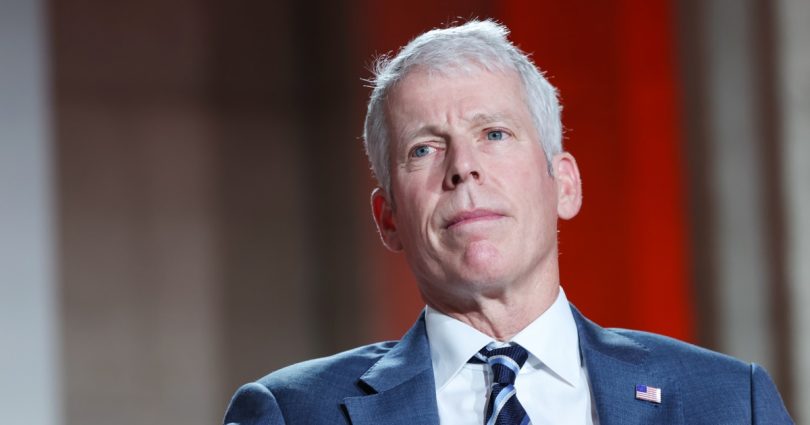

Energy Secretary Chris Wright said Sunday that there’s “a very good chance” gas prices could drop below $3 per gallon by summer, predicting that in “a few more weeks” the U.S. will have “removed the risk” of Iran’s continued threat on global energy supplies.
“Americans are feeling it right now. Americans will feel it for a few more weeks,” Wright told NBC News’ “Meet the Press” about rising gas prices amid the joint U.S.-Israeli war on Iran.
Wright added that once the war is over, “we’ll go to a world more abundant in energy, more affordable in energy, and less risky for American soldiers and commerce in the Middle East.”
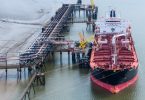
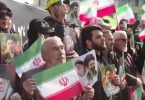
Oil prices continued to soar globally this week as Iranian leaders have vowed to keep the Strait of Hormuz, a vital maritime passageway for oil tankers, closed.
Asked Sunday whether the Strait of Hormuz is safe for ships right now, the energy secretary said, “No, no it is not,” but added that making it safe for reopening is “one of the objectives at the end of this conflict.”
In a phone call Saturday, President Donald Trump dismissed concerns about rising gas prices in the U.S., telling NBC News, “I think they’ll go lower than they were before, and I had them at record lows.”
“There’s so much oil, gas — there’s so much out there, but you know, it’s being clogged up a little bit. It’ll be unclogged very soon,” the president added.
According to GasBuddy, gas prices were averaging $2.94 per gallon in the U.S. on March 1, the day after the war began. On Saturday, they were averaging $3.70.
Asked directly whether gas would drop below $3 per gallon before the summer travel season, the energy secretary said, “There’s a very good chance that’ll be true.”
“There’s no guarantees in war. The time frame’s still not entirely clear, but I think that’s certainly a goal of the administration,” he added.
On Saturday, U.S. forces conducted military strikes on Kharg Island, a critical hub for Iran’s oil production.
In the phone interview Saturday, Trump said that “we totally demolished Kharg Island,” but added: “Except, as you know, I didn’t do anything having to do with the energy lines, because having to rebuild that would take years.”
Iran has warned that if the U.S. strikes its oil infrastructure, it will retaliate by striking the oil infrastructure of the U.S. and its allies in the region.
Also on Saturday, the president said he was asking the leaders of other countries to work together to secure the Strait of Hormuz.
In a Truth Social post, he wrote that “hopefully China, France, Japan, South Korea, the UK, and others, that are affected by this artificial constraint, will send Ships to the area” so that Iran will no longer threaten the strait.
Later in the phone interview, Trump said some countries have “not only committed, but they think it’s a great idea,” but he declined to name any countries.
Wright on Sunday also demurred when asked what countries have committed to helping the U.S. reopen the strait, but said, “I have been in dialogue with some of those nations, so I know that to be true.”
“The world depends on the flows through Hormuz,” he added, listing several Asian countries — Japan, Korea, China, Thailand and India — that he said are particularly dependent on the strait for their energy supply.
China, a strategic partner to Iran, hasn’t publicly committed to helping the U.S. reopen the strait. But Wright told “Meet the Press” moderator Kristen Welker in response to questions about whether the U.S. is prepared to share intelligence with China that “the United States is always in dialogue with the Chinese.”
“Opening the Strait of Hormuz is even more important for China than it than it is for the United States,” Wright added, saying, “I do expect China will be a constructive partner in reopening” the passageway.
In a separate interview on ABC, Wright said that once they’re able, “all U.S. military assets” will work to reopen the Strait of Hormuz.
“Right now, our focus is destroying their military capabilities, including those that are used specifically to threaten the straits. But we need to finish those tasks first, and you will see the straits open again in the not too distant future,” he added.
His remarks come just days after three U.S. officials told NBC News that 5,000 additional Marines and sailors are deploying to the Middle East.
In the “Meet the Press” interview, Wright also responded to questions about how much longer the conflict with Iran could last.
Asked whether the war could be over in a few more weeks, the energy secretary said, “I think that’s the likely time frame.”
Trump and other top officials in his administration have publicly sent mixed messages about how long the war could continue, with the president on Saturday saying, “We’ve knocked out most of their missiles. We’ve knocked out most of their drones. We knocked out their manufacturing of missiles and drones, largely. Within two days, it’ll be totally decimated.”

Sen. Adam Schiff, D-Calif., in a separate interview on “Meet the Press”, slammed the administration’s messaging around ending the operation telling Welker “When you ask how long this war is going to go on, the secretary can’t tell you, the president won’t tell you, and it’s because not having a clear object in mind when we began this war, it makes it very difficult to tell when its objectives have been accomplished.”
“I don’t think the war is worth the costs, and it has already unleashed a lot of things that should have been foreseen, like the closing of the strait, like Iran’s attack on its neighbors, but it’s not clear that the president had a plan for any of this,” he added.
On Saturday, Trump said that U.S. officials expected Iran to close to the Strait of Hormuz in response to U.S. and Israeli strikes but he was “surprised” that Iran launched strikes against other Middle Eastern countries in response to joint operation.
It was “the biggest surprise I had of this whole thing,” the president said.
Source link