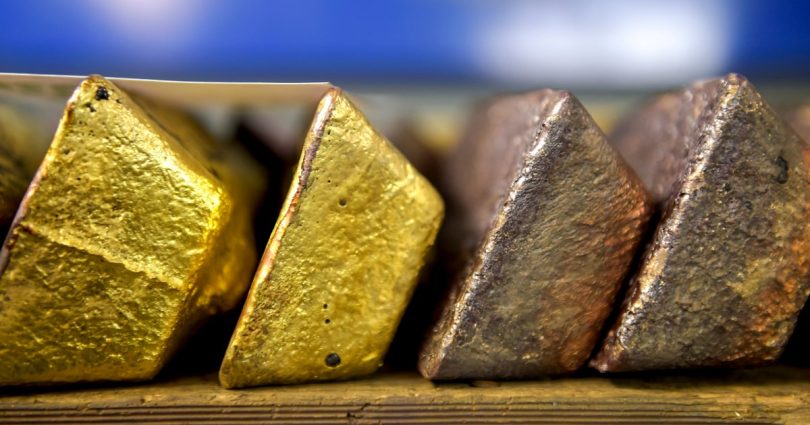


Gold and silver prices are about to record their biggest annual gains since 1979.
Rising sharply in late April after President Donald Trump’s rocky global tariff rollout, the price of gold has soared nearly 70% in 2025. Silver, up more than 30% in December alone, has surged more than 160% this year.
While there are a few factors at play, the rally can trace its origins to the unease over volatile trade policies announced by the Trump administration earlier this year, as well as a concern that they could weaken the U.S. dollar and hurt its appeal around the world. Often referred to as “safe haven” assets, precious metals rise when investors move out of more volatile assets, like stocks.
In contrast to precious metals, the U.S. dollar’s value has declined more than 9% in 2025, as compared to a basket of other major currencies such as the euro and yen.
Gold in particular rose this year as “central banks and investors embraced the precious metal’s qualities as a non-sovereign asset,” according to analysts at RBC Capital Markets.
“The broader economic environment continues to provide multiple factors that historically have influenced gold price movements,” they said in a Dec. 22 note.
Central banks around the world, which buy gold as a safe and secure asset to fill their reserves, have been net buyers of the metal for months, according to the World Gold Council. In October, the most recent data available, central banks ramped up their buying even more, adding 53 tons of gold to their reserves. Big purchases can potentially restrict the available gold supply, thus driving up its overall price.
After Trump’s so-called “liberation day” in early April, traders and some of the largest banks flew stocks of the metals to the U.S. in order to front-run the newly imposed array of tariffs. That’s because the City of London serves as the world’s primary clearing point for gold and other major precious metals. In recent years, New York City has also added many vaults, where some of the metals rushed in before the first wave of this year’s tariffs likely remain today.
Silver, meanwhile, is a key component in electrical circuits and switches, as well as electric vehicles and solar energy products. Gold differs because it is historically much less volatile than silver, so it’s widely used as a long-term store of value and a way to diversify an investment portfolio.
Silver’s meteoric rise briefly sputtered after Tesla CEO Elon Musk wrote on X on Dec. 26 that the soaring silver prices are “not good.”
“Silver is needed in many industrial processes,” Musk added in the post.
Still, in the days since, silver resumed rising despite a drop of more than 8% on Monday. As of midday Tuesday, it was up 10%. Unlike gold, whose price is currently more than $4,300 per ounce, silver is trading at a much lower $77, making it more susceptible to volatility and retail trading.
Gold also fell on Monday by more than 4% before a slight rebound Tuesday. “Profit taking and reported progress on a Ukraine peace deal could be significant catalysts in the downside move,” said Chris Waterbury, derivatives manager at Charles Schwab.
On Monday, Trump held a face-to-face meeting with President Volodymyr Zelenskyy of Ukraine regarding the state of the war Russia is waging on Ukrainian territory. Both leaders sounded an optimistic tone after the talks, with Zelenskyy telling reporters in a news conference that the talks were “great.”
The most well-known gold ETF, which trades under the ticker symbol “GLD,” has recorded more than $20 billion of inflows from investors this year. One of the most well-known silver ETFs, which trades as “SLV,” has recorded almost $3.5 billion of inflows this year. Those funds are typically how average investors take part in the precious metals trade.
Gold ETFs overall experienced five straight months of investor inflows through November, according to the World Gold Council, which operates the “GLD” ETF.
Source link