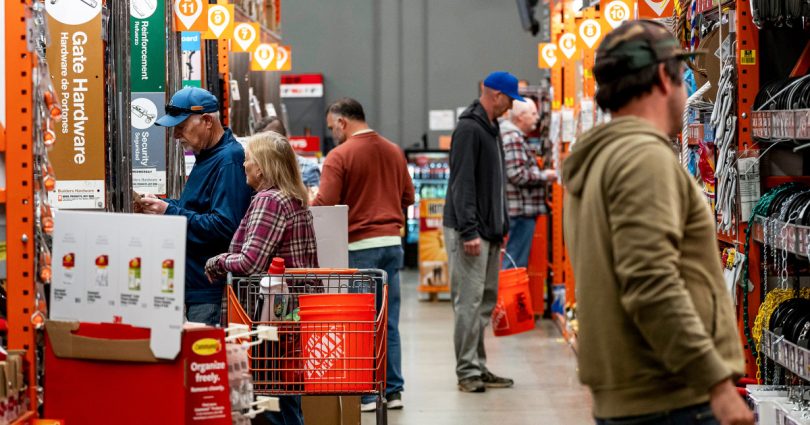

Four of America’s largest retailers will report their quarterly earnings this week, and the most pressing question the reports will answer is whether Americans are finally starting to buckle under the weight of rising prices.
Subscribe to read this story ad-free
Get unlimited access to ad-free articles and exclusive content.

The results from Home Depot, Lowe’s, Walmart and Target are expected to offer one of the clearest snapshots yet of how U.S. households are navigating an economy increasingly under strain from soaring gas prices, stubborn inflation and elevated borrowing costs.
The stakes are especially high as rising energy prices continue to ripple through the broader economy, driving up transportation, grocery and household costs when many consumers are already stretched thin.
Economists, investors and journalists will parse the financial results and the accompanying commentary from corporate leaders looking for explicit signs of strain: Are shoppers trading down to cheaper products? Delaying home improvement projects? Or pulling back on discretionary purchases to prioritize essentials?

FORSUBSCRIBERS

What’s behind America’s new inflation spike
01:24
Home Depot kicked off the closely watched earnings parade Tuesday morning, reporting a 5% increase in sales from a year earlier.
But executives also said the consumer is still spending selectively.
“The main thing is just this uncertainty that’s holding them back for taking on large projects,” Home Depot CEO Ted Decker told analysts during the company’s earning call, adding that “larger discretionary projects remain under pressure.”
Still, he said customers remain engaged in smaller seasonal purchases and outdoor projects, with strength in categories like grills, patio furniture and outdoor power equipment.
Meanwhile, the company’s chief financial officer told CNBC that homeowners are “more protected financially” than other customers, but noted that they’re also holding off on more expensive projects. Affordability is a big challenge in the housing market, where average mortgage rates nationwide Monday hit 6.68% for a 30-year fixed loan, according to Mortgage News Daily.
“If it’s higher for longer on rates in a slow housing market,” Decker added on the call, “we’re just going to have to keep working our way through this period of moderation.”
The Home Depot results echo early spring spending data that suggests consumers are still holding up all right — but not evenly.
According to a recent report from the Bank of America Institute, total credit and debit card spending per household rose 4.8% in April from a year ago, the strongest single-month increase in three years.
But beneath the headline resilience, economists say, an even sharper divide is emerging.
The so-called K-shaped economy — in which spending by wealthier households accounts for an outsized share of overall consumer spending while lower-income families struggle — has widened in recent months, according to economists.
The report found lower- and middle-income consumers were increasingly pulling back on discretionary spending categories like dining and entertainment, while wealthier households — boosted by strong stock market gains and rising home equity values — continue to spend at a healthy pace.
And with inflation running at 3.8% in April, above the wage growth rate of 3.6% that month, economists warn that financial pressure on lower-income households could intensify.
And if the gap continues to widen, it could complicate the Federal Reserve’s path under the incoming chair, Kevin Warsh, who is expected to be sworn in as the central bank’s next chief Friday.
Warsh, who already said he was open to “regime change” at the Fed, will assume the top job when persistent inflation could force the central bank to keep interest rates higher for longer than anyone could have imagined just a few months ago — to prevent the economy from overheating.
Higher benchmark interest rates from the Fed have a direct impact on consumer lending costs, which means the same elevated borrowing costs would continue to keep the pressure on businesses and consumers who are already struggling to keep up with rising costs.
“While households still have some near‑term buffers — including tax refunds and savings — these too are unevenly distributed, underscoring the growing gap between headline resilience and stress experienced by some households,” Bank of America economists said.
Source link