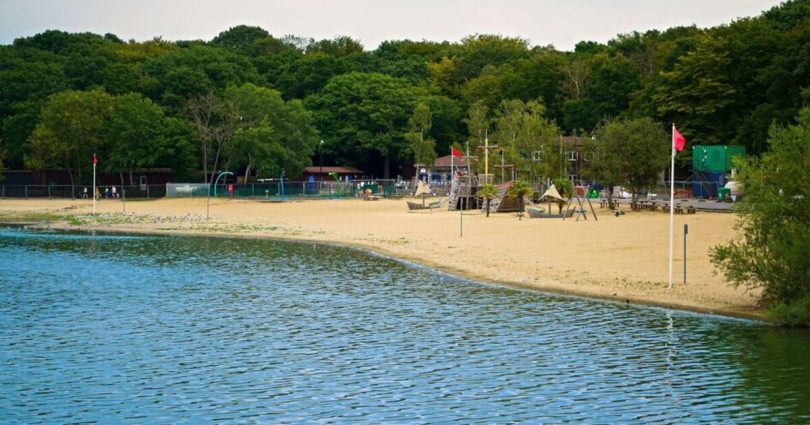

A secret beach over 50 miles from the sea is home to the UK’s longest miniature railway. Ruislip Lido is a reservoir and artificial beach within the London borough of Hillingdon.
It is situated in Ruislip Woods, a Site of Special Scientific Interest and National Nature Reserve with ancient woodland. The lido is a popular location for sunbathing and beach games, at over 54 miles from the seaside. Swimming is officially not allowed owing to lack of lifeguards, blue-green algae, cold-water shock, unpredictable depth, submerged objects, and swimmer’s itch. It is home to a sandy beach, pirate ship play area, and free splash pad, and is the only beach accessible by the London Underground. Fishing is also permitted with a licence, as well as a boathouse, woodland walks, and wildlife to enjoy. A narrow gauge railway, the Ruislip Lido Railway was opened in 1945.
Running from the main station at Woody Bay by the lido’s beach, the railway passes through Ruislip Woods to Willow Lawn station and tea room near the lido’s car parks. It is the longest 12 in (305 mm) gauge railway in the UK at just over a mile.
Originally built by the Grand Union Canal Company over a much shorter route, the line has been extended in recent years and now covers more than two thirds of the perimeter of the reservoir.
Though originally created as a feeder basin for the Grand Junction Canal in 1811, the reservoir did not fulfil its intended purpose because the water became polluted by flooded land, and its role as a feeder ceased in 1851.
The reservoir was reopened in 1933 as a lido, with an Art Deco-style main building designed by George W. Smith, together with an area reserved for swimming.
The building included a cafe and changing rooms, and featured a terrace with steps leading into the enclosed swimming pool. Rowing boats were available for hire, with boathouses on the western side of the reservoir.
An enclosed boating area for children was later constructed. The reservoir became a popular location for water-skiing, and televised championships were often held there.
During the Second World War, the lido was secretly used by the Royal Air Force to train aircrew based at RAF Northolt and RAF Uxbridge in water survival methods.
Having fallen into a state of disrepair during the 1970s and 1980s, the lido underwent renewal works, and was the subject of an enhancement project unveiled by the London Borough of Hillingdon in January 2010.
Source link


