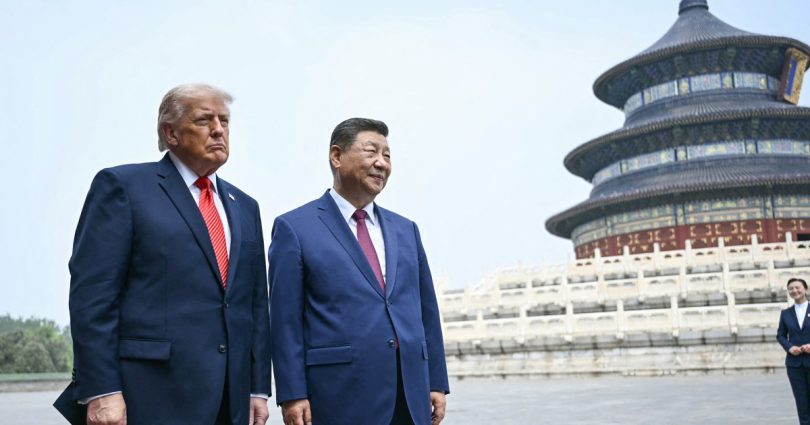

BEIJING — Though U.S. President Donald Trump said he and Chinese President Xi Jinping “discussed almost everything,” their superpower summit here this week produced no sweeping agreements and concluded with just a handful of measurable outcomes.
Subscribe to read this story ad-free
Get unlimited access to ad-free articles and exclusive content.

Instead, each side lavished praise upon its counterpart and appeared to count the level-setting as an important step toward stabilizing the relationship.
“Neither side moved on the issues that matter most,” Craig Singleton, the China program senior director and senior fellow at the Foundation for Defense of Democracies, said in a statement. “Technology, Taiwan, Iran, rare earths, and supply-chain dependence remain unresolved. The summit helped manage the moment, but the underlying contest now returns to the same pressure points.”
Among those pressure points is Taiwan, with Xi warning of “clashes and even conflicts” with the United States over the issue if not handled “properly.” While not new, the force of Beijing’s warnings showed how sensitive the issue has become for China, with Xi framing it as the most important issue in U.S.-China relations, according to a Chinese readout of the meeting.

FORSUBSCRIBERS
American tech CEOs join Trump in China
01:24
Taiwan was not mentioned in Washington’s readout, however.
Trump later told reporters that he discussed arms sales to Taiwan “in great detail” with Xi and would make a decision about a long-delayed $14 billion package “shortly.”
Trump’s repeated comments about discussing those arms sales with Xi have alarmed Taiwan supporters, with some experts saying that would violate longstanding U.S. policy prohibiting such consultations.
He said he declined to answer when Xi asked whether the U.S. would defend Taiwan militarily, in keeping with another longstanding U.S. policy of “strategic ambiguity,” but that “the last thing we need right now is war 9,500 miles away.”
Trump said it was Xi who raised the issue in their discussions: “What am I going to say? I don’t want to talk to you about it, because I have an agreement that was signed in 1982?”
For China, the talks highlighted another pressing question of whether the status quo on trade with Washington could hold after the two sides struck a truce last year.
One thing they didn’t discuss, Trump said, was a reduction in tariffs.
Beijing faces its own long-standing economic problems, including high youth unemployment, weak consumer demand and concerns about how long it can withstand energy shocks from the Iran war.
“The Chinese have realized that nothing they can do is going to change the approach of the U.S. trade policy for the next couple of years, and so what they are focused on is trying to come to some arrangement where they can survive without suffering a major economic hardship,” said a former senior Trump administration trade official, requesting anonymity to speak candidly about a sensitive dynamic.
This person continued: “Trump clearly is not in the mood to make concessions, and if you look at the arc of his decision-making, he goes through periods of being less stubborn. That doesn’t seem to be the situation we’re in now.”
The ongoing war with Iran, for whom China remains an important partner, loomed over the visit, and Trump said he will make a decision over the next few days on whether to lift sanctions on Chinese oil companies that buy Iranian oil.
Separately, he reiterated his maximalist view of the negotiations on Iran, telling Fox News that failure to come to the table on a nuclear agreement would result in “annihilation.”
Michael Pillsbury, a China scholar at the Heritage Foundation, said that going into the meetings with China, Trump had made a deliberate choice to hold off on ultimatums to keep the dialogue open.
“Trump has portrayed everything as ‘a talk,’ which is much easier for the Chinese to go along with than if he said, ‘I’m coming to cut something off,’” Pillsbury said.
The approach, he said, was a departure from Trump’s first-term posture, and the two leaders discussed how they could meet three more times this year, during a state visit in Washington, at the G20 and at APEC.
“Trump knows he’s doing something new. This is not the November 2017 approach,” said Pillsbury, who advised the administration’s policy at the time. Back then, he noted, China had far less leverage to deploy.
“When Donald Trump made his first official state visit to China nearly a decade ago, its overall power lagged far behind that of the United States,” agreed Comfort Ero, the president and CEO of International Crisis Group, speaking in a briefing. Now, “Trump says that the two countries constitute a ‘G2.’ Military officials already consider China an equal — and the Pentagon’s national defense strategy contends that it is the most powerful competitor that Washington has faced since the 19th century.”
Xi referenced the new dynamic ahead of the talks, invoking the Thucydides Trap, which suggests a tendency toward conflict when a rising power threatens an existing one.
Trump, in his first Truth Social post from China, sought to gloss over that rhetoric. Xi had “very elegantly” referred to the United States “as perhaps being a declining nation,” Trump wrote and offered some of his own analysis: Xi, he said, “was referring to the tremendous damage” inflicted during the administration of his predecessor Joe Biden.
He added that Xi congratulated him on “many tremendous successes in such a short period of time.”
The shift in the balance of power underpinned the week, as did an agreement, forged when Trump and Xi met last year in Busan, South Korea, on the sidelines of the Asia-Pacific Economic Cooperation summit, for a one-year moratorium on export licenses for rare-earth minerals. The two sides also finalized a trade truce at the time, after Trump hiked tariffs on goods from China as high as 145%.
The former Trump administration official said that despite investments to bolster domestic extraction and refining of rare-earth materials, U.S. efforts have been slow to get off the ground.
“The Chinese are not in a position to come to agreements about the future of critical minerals, which is really one of their principal levers of power,” the official said.
Extending that moratorium would be a major win for Trump, though White House officials declined to signal whether they anticipated any developments in Beijing.
“All the Chinese have to do is say, ‘Look, we’re going to let this stuff exit our fortress,’” the former official said. “It doesn’t even have to be said directly. It can just be, ‘Oh, we’re gonna revisit the question.’ Everyone knows what they mean.”
On Friday, the two-day summit concluded with commitments announced by Trump for purchases of 200 Boeing aircraft, with a tentative promise that the order could be even higher if it goes well.
He said they also made a deal for China to buy “billions of dollars” of soybeans.
Trump said he also raised the case of Jimmy Lai, 78, the Hong Kong pro-democracy publisher who was sentenced to 20 years in prison earlier this year after being convicted on national security charges, with no result. China says Lai, who pleaded not guilty, was the “mastermind” behind anti-government protests that roiled the Chinese territory for months in 2019.
“I did bring it up. It’s a tougher one,” Trump told reporters.
Another tangible victory for Trump could come if Washington cements China’s cooperation to help end the conflict in Iran, which China says “should never have happened.” Trump said Friday that he did not want to ask Xi for any favors “because when you ask for favors, you have to do favors in return,” but that the two agreed the war needed to come to an end. And, he noted to Fox News, Xi promised not to give military equipment to Tehran.
The president raised the war with Iran repeatedly in his public remarks, while China’s official readout of their bilateral meeting made no specific mention of Iran, saying only that the two leaders “exchanged views on major international and regional issues including the Middle East situation.”
Washington’s readout said that Xi had voiced interest in purchasing American oil, a development that, if realized, would reduce Beijing’s appetite for Iranian oil and deal a potential economic blow to Tehran, as China is the primary buyer of Iranian oil.
Still, Trump acknowledged to Fox News, “They buy a lot of their oil there, and they’d like to keep doing that.”
Pillsbury said Trump’s decision to bring his defense secretary on the trip — something he did not do in 2017 — suggests an attempt to demonstrate to China a level of trust in what the U.S. is doing now with Iran and plans to do in the future.
“Iran will get the message that their biggest friend is having secret consultations with their biggest enemy,” he added.
In a statement on X after Trump boarded Air Force One, Chinese Foreign Ministry spokeswoman Mao Ning bid “farewell” to the Trump team and summarized the outcome of the visit as “a new beginning.”
On that, Trump seemed to agree, writing on Truth Social: “Hopefully our relationship with China will be stronger and better than ever before!”
Source link