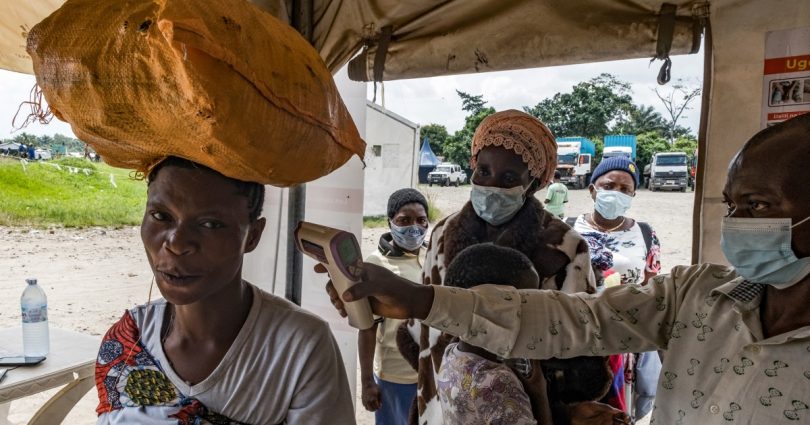

Until last year, the U.S. Agency for International Development was part of a time-tested system for dealing with Ebola. In its absence, a dozen former federal employees told NBC News, the U.S. response to the growing outbreak has been slow and disjointed.
Subscribe to read this story ad-free
Get unlimited access to ad-free articles and exclusive content.

The Trump administration hollowed out USAID last year, canceling the majority of its programs and firing most of its staffers. Roughly 1,000 programs were salvaged and absorbed into the State Department.
In interviews, former top officials at USAID, the Centers for Disease Control and Prevention, National Institutes of Health and the White House said that if USAID was still intact, it’s possible its resources might have helped contain the virus in this new outbreak and even saved lives. The outbreak was identified last week in the Democratic Republic of Congo, but Ebola was likely spreading undetected for weeks before that. As of Wednesday, the number of suspected deaths stood at 139 and cases at 600, according to the World Health Organization, though the true numbers are feared to be much higher.
“What we’ve lost is speed, which is the most important thing in an outbreak like this,” said Nicholas Enrich, former acting assistant administrator for global health at USAID.
Enrich and other experts said USAID programs could have helped laboratories in Congo detect the virus earlier, sped up the distribution of personal protective equipment to hospitals and deployed local community health workers to screen people for symptoms and track down those who may have been exposed.
Enrich said he watched those systems, which had made a difference in past outbreaks, unravel in early 2025 as the Trump administration scaled back foreign assistance.

Community health workers with expertise from past outbreaks have since had to find other jobs, said Dr. Daniel Bausch, visiting faculty at the Geneva Graduate Institute and a former medical officer at CDC.
“Now they’re driving a taxi in Kinshasa or selling fruit somewhere,” Bausch said. “So this cadre of reasonably trained people that you can employ just isn’t around.”
The International Rescue Committee, a former USAID contractor, said U.S. funding cuts last year forced it to downsize its presence in Ituri, the province where the outbreak is centered, including scaling back on surveillance efforts and sanitation measures such as handwashing stations, showers and latrines. Heather Reoch Kerr, IRC’s country director for Congo, said the lack of donor funding has reduced the group’s ability to distribute PPE kits.
“Today many facilities in affected areas are operating without basic protective supplies,” she said in a statement.
The State Department has repeatedly denied that changes to USAID have hampered the country’s Ebola detection or response capabilities.
“It is false to claim that the USAID reform has negatively impacted our ability to respond to Ebola,” spokesman Tommy Pigott said.
In a news release, the department said it had mobilized $23 million in foreign assistance.
“This funding bolsters each country’s own response, supporting surveillance, laboratory capacity, risk communication, safe burials, entry and exit screening, and clinical case management,” it said.
On Tuesday, the State Department also announced a plan to fund up to 50 clinics to “provide emergency screening, triage and isolation capacity.”
As for the delay in identifying the outbreak, a senior State Department official said “there was no specific person or program associated with USAID in this region that would have detected this.”
Another senior State Department official said USAID partner organizations are usually the first to hear about an outbreak, and “the same partners are actually still on the ground.”

Dr. David Heymann, a former CDC medical epidemiologist who is now a professor of infectious disease epidemiology at the London School of Hygiene & Tropical Medicine, said the core issue in his view isn’t a lack of money flowing from the U.S.
“The problem is that they’re not working internationally,” he said. “They’re not working with the international agencies.” But “whether the response will be injured because of that, I don’t think anybody can say” yet, he added.
The U.S. withdrew from the World Health Organization last year, with Trump accusing it of mishandling the Covid pandemic. In an outbreak, the WHO helps with international coordination, technical expertise and delivering medical supplies and equipment where they’re needed.
The White House did not respond to a request for comment.
With USAID gone, the CDC has taken on a greater role in the outbreak response. The agency said this week that its offices in Congo and Uganda are helping with surveillance, laboratory diagnostics, contact tracing and distributing PPE.
“We have a long-standing presence with a large country office in Uganda with nearly 100 staff and we’re in DRC with nearly 30 staff members,” Dr. Satish Pillai, incident manager for CDC’s Ebola response, said Tuesday on a press call. He added that the agency plans to deploy more staff.
Enrich said the CDC’s role in past outbreaks was mostly to provide technical knowledge about Ebola.
“They’re not equipped or prepared or organized to coordinate a broad response,” he said. “Their job is more making sure that the tests that are coming in are handled properly and the results are distributed effectively.”
Bausch said he worries that CDC staff can’t stand in for the workers USAID used to employ.
“They don’t speak the language. They don’t know the culture. They don’t know the geographic terrain. They don’t have expertise in the region’s security and safety issues,” he said. “Those people who really make things work are local people that are hired, who may have experience with this from previous outbreaks.”
A CDC official with direct knowledge of previous outbreaks in Congo, who asked to remain anonymous because they are not authorized to speak on behalf of the CDC, said security concerns in the country can make it difficult for the federal government to get employees to affected regions. The area where the outbreak started has recently seen conflict between the Congolese government and the rebel group M23.
“Working with USAID in east Congo is the only way to control Ebola,” the official said.

Andrew Nixon, a spokesperson for the Health and Human Services Department, said the CDC has “extensive expertise” in viral hemorrhagic fevers, the category of diseases that includes Ebola.
“CDC is fully equipped to protect Americans and mitigate risks through experts in this disease area,” he said.
The first suspected case in this outbreak dates back nearly a month: A health worker reported symptoms consistent with Ebola on April 24. However, local health officials didn’t identify the virus’s strain until three weeks later. A May 15 laboratory analysis confirmed that it was the Bundibugyo virus, a rare type of Ebola for which there is no approved vaccine or treatment.
Congolese officials told Reuters on Monday that a lab in the Ituri province did not have the proper equipment to test blood samples for Bundibugyo and set the samples aside rather than send them to a different lab right away. Eventually, Reuters reported, the lab shipped the samples to Kinshasa — but at the wrong temperature and in the wrong quantities, which made them harder to analyze.
Enrich said USAID might have been able to offer technical expertise and support in that scenario.
“The fact that this has been circulating for this long indicates that the system has degraded,” said a former USAID official who requested not to be named to protect their public health relationships. “Under USAID, the U.S. had people directly involved in the emergency operations center in DRC, people that would be aware of what the laboratory capacity was, and when there were gaps and things weren’t running well.”
Many hospitals in Congo and Uganda are waiting on resources from the CDC, WHO and humanitarian groups.
Dr. Herbert Luswata, who works at Bwera Hospital in Kasese, Uganda, near the Congo border, said his facility doesn’t have enough N95 masks, disposable aprons or gloves, and is also short on healthcare workers who can help with infection prevention and control.
“We are really very scared,” he said. “We are not safe at all.”
Luswata, the former president of the Uganda Medical Association, said he’s aware of some former USAID contractors who are volunteering their services but aren’t sure when or if they’ll get paid. So far, he said, CDC health experts have not visited his hospital, despite arriving swiftly in past outbreaks.
“The response is too slow and inadequate, not anywhere close to the standards that are required in a response for an epidemic like Ebola, which we know has a very high fatality rate,” Luswata said. “We are too exposed as health workers.”
Source link